
Launching the Housing Innovation Coworking Space: How PIE is Helping to Reimagine Innovation in Housing

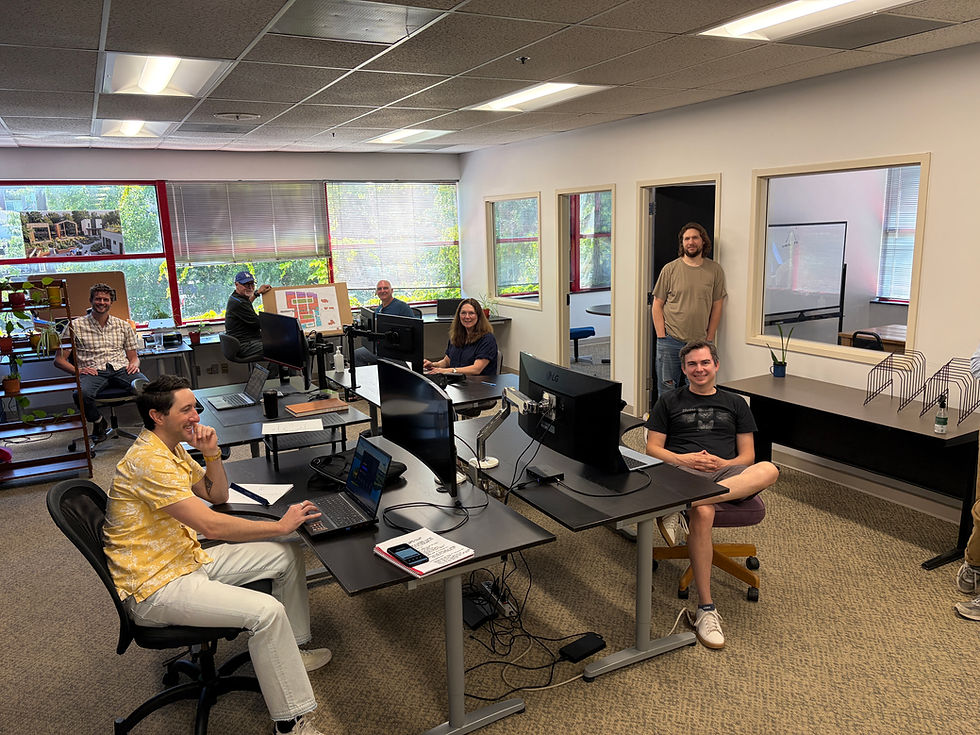
Founded in 2009, PIE (Portland Incubator Experiment) began as an experiment to enable established organizations to more effectively collaborate with startup communities in mutually beneficial ways. Now, that same spirit of experimentation is fueling something new: a peer-to-peer coworking space, called the Housing Innovation Coworking Space, designed specifically for organizations working to address our region’s housing underproduction crisis through innovation. Launched with support from PIE, the Coworking Space is the Missing Middle Housing Fund’s latest effort to drive housing innovation.

We sat down with Rick Turoczy, PIE’s Co-founder and General Manager, to talk about PIE’s roots, its evolution, and why he believes this new model of collaboration might be exactly what Portland's housing innovators need.
The “E” stands for “Experiment”
At its core, PIE has always been defined by experimentation. "We take the E in PIE very seriously,” said Turoczy. “We never really do the same thing twice."
Since launching in 2009, the PIE organization has worked with hundreds of founders and mentors, continually adjusting its approach based on what Portland's startup community needs, rather than importing models built for Silicon Valley or Seattle.

"PIE originally just started as a coworking space for founders to work out of," Turoczy explained, "and eventually morphed into what it's more known for today - a structured mentorship program for startup founders."
That distinction matters to Turoczy. He describes Portland as "the land of accidental entrepreneurs", a community where people tend to fall into business by pursuing a passion or product, rather than setting out to solve a market problem from day one. “It's a strength,” he says, “But also a risk. Not every product is a business, and some people often conflate the two."
Turning Innovation Toward Housing
PIE’s move into housing innovation traces back to 2020. Amid the challenging national narratives swirling around Portland at the time, PIE started asking a bigger question: How could innovation be used to positively affect those experiencing houselessness?
Inspired in part by PIE’s existing partnership with Autodesk, a company with deep roots in architectural software, the PIE team opened up an application and built a cohort of organizations working on different pieces of the housing puzzle. The Missing Middle Housing Fund was a part of that cohort, which is where MMHF’s relationship with PIE began.
One early piece of guidance shaped PIE's approach significantly: don't build solutions that directly serve people experiencing houselessness and then risk pulling that support away.
"Experimenting with technology is fine, but you can't experiment with people's lives in that manner," Turoczy said.
Instead, PIE found its strongest traction working with organizations positioned a step or two removed from the frontline crisis - teams solving "upstream" problems that ultimately eased pressure downstream.
It's a distinction Turoczy sums up simply: impact often comes from fixing the systems around a problem, not just the problem itself.
Peer-to-Peer Over Expert Mentorship
PIE’s earlier programming leaned heavily on expert mentorship, pairing first-time founders with seasoned advisors who could help them navigate specific challenges. It worked. But it also came with a cost, both financial and structural. PIE has spent the past several months assessing its programming model and questioning whether a focus on expert mentors is the only way to build value for founders.

The new Housing Innovation Coworking Space seeks to explore that question. Rather than centering the model around expert-led programming, it's built around something less proven, but potentially just as powerful…What happens when you put similarly staged, like-minded founders in the same room and let community take shape organically?
“Our co-residency with other entrepreneurs at the PIE Space at Autodesk led to real partnerships and business growth. For instance, we now work with UrbanForm in 20 communities and counting across Oregon, and we directly invested in HumanKind Homes. We are hoping to recreate that proximity to like-minded entrepreneurs, and are so grateful for Rick’s support and guidance,” said MMHF’s CEO, Nate Wildfire.
The Housing Innovation Co-Working Space, located at 333 SE 2nd Ave in SE Portland, includes:
Missing Middle Housing Fund, a state-wide housing innovation non-profit, obsessed with creating more attainable, workforce housing through the four key production opportunity areas of product design, materials, and assembly; financing and funding; workforce development; and policy reform
UrbanForm, a technology company featuring a digitized zoning platform (think Google maps for zoning)
Big Marks Studio, a design collaboration, research, and consulting firm working with the mass timber industry
Also located in the same space are Elemental Building Technologies, a steel-modular building company; DL VIZ, an architectural visualization technology company; and architect studio, Iris Design Group.

"I know what expert mentorship is capable of doing," Turoczy said. "I'm not confident we have a full scope of how impactful peer-to-peer mentorship can be."
In this new Coworking space, Turoczy is interested in examining a few key metrics of success, including the cost and speed to help organizations be successful. PIE’s past cohort-based programs were designed to be short-term, university-style experiences. Founders went through an intensive few months together, then moved on, occasionally reconnecting down the line. Turoczy is curious whether a shared, ongoing workspace can build deeper, longer-lasting trust between founders - support that doesn't have a built-in expiration date.
What's Next
For now, the Housing Innovation Coworking space is a focused, early-stage experiment rather than a full relaunch of PIE’s previous programming. But Turoczy is clear about who should reach out. Anyone working in housing, or curious about how innovation can shape the lived environment, is welcome to get in touch.
The MMHF is proud to continue building alongside PIE as this next chapter takes shape, and grateful for partners like PIE, who are willing to keep experimenting, even when the answers aren't obvious yet.
Interested in learning more about the Housing Innovation Coworking Space or getting involved? Reach out to amy.snyder@missingmiddlehousing.fund to learn more.


So happy to see this collaboration continue!